Could One of These Six Be the Yankees' 2026 1st-Round Pick?


Yankees Draft Watch: Six College Players for the Yankees’ Draft Board
By the time the Yankees finally get on the clock at night one of the MLB Draft, many of the top college players will have already been selected. What will be left is a group of talented, however imperfect, prospects. Nonetheless, if you are familiar with recent Yankees’ drafts, this is not unique to this class.
The college demographic is one that the Yankees have shown the most comfort evaluating, as well as the most success in developing. Many of the Yankees’ top homegrown players have risen from the college ranks. On the pitching side, they’ve treated this as more of a “volume business” by drafting a large number of arms with a specific set of traits (pitchability, projection, etc.) in the middle to late rounds. Still, this does not mean that you should totally count them out on pitching early. Due to the scarcity of college pitching early in this class, I am highly doubtful of this pick going in that direction, but for spoilers I did include one arm just to cover my bases. For hitters in early rounds, the Yankees have prioritized bat-first profiles at premium positions (C, SS and CF). If the Yankees do decide to go the route of college player, these are some names I anticipate they will consider:
Honorable Mentions:
Will Gasparino, University of California, Los Angeles | 21 | 6'6 220 | R/R | OF

2026: .324/.423 - 1.071 OPS | 34 XBH - 20 HR, 64 RBI | 30 BB - 55 K
Gasparino has some of the easiest power in the entire college class. A physically imposing 6’6” frame, Gasparino is not just a one trick pony. He’s an above average athlete, especially for his size, with a legitimate shot to stick at centerfield long term. Though he comes with swing-and-miss concerns (as does nearly every 6’6” hitter), the package of tools gives him enticing enough upside to make him at the very least a thought in the early rounds.
Tyson LeBlanc, Kansas University | 21 | 6’0 195 | R/R | SS

2026: .341/.425 - 1.131 OPS | 40 XBH - 25 HR, 69 RBI | 11/12 SB | 38 BB - 50 K
Looks can be deceiving, while LeBlanc lacks the loud toolset that would earn him first round consideration, his performance tells a much different story. In his lone season at Kansas, LeBlanc slashed an eye-popping .341/.425/.706 with 25 homers. It’s average power at best, but his knack for pulling the ball in the air has helped him maximize his strength. He does everything at a high level, despite not being the most physically gifted player. Though a first-round grade is rather lofty for LeBlanc, he has proven himself more than worthy of being a second or third rounder. He fits right into that mold of college performers that the Yankees have taken early.
6. Dee Kennedy, Kansas State | 21 | 5’11 180 | R/R | SS

2026: .357/.461 - 1.194 OPS | 40 XBH - 20 HR, 69 RBI | 22/26 SB | 38 BB - 50 K
It is amazing what the gift of eyesight can do for an athlete. Since getting LASIK after the 2025 season, Kennedy has transformed into a completely different player. As a hitter, Kennedy is seeing the ball better and posting elite swing decisions. He nearly halved his strikeout rate (30.3% → 18.4%) while running a chase rate in the mid-teens. He’s hitting the ball harder and, in the air, more often, allowing him to get the most out of his 5’ 11” frame.
In high school, Kennedy was an elite runner, and while he has slowed down as he’s filled out, he remains a superb athlete. His speed shows up on the base paths, where he posted a 20-20 season. This year, he was handed the reins at shortstop and showed that not only can he handle the position, but he can do so as a plus defender.
Kennedy’s breakout season has vaulted him up into top 100 pick territory. Though he might not be a first rounder, he won’t have to wait much longer to hear his name called. His tremendous defense and swing decisions will provide a high floor as he works his way up the minor league ranks. The Yankees have shown a tendency to target high floor college bats in the early rounds (Roc Riggio and Kaeden Kent). There’s no telling whether Kennedy will even last long enough for that to happen, but if he does, he’ll fit that mold well.
5. Carson Wiggins, University of Arkansas | 21 | 6’5 215 | R/R | RHP
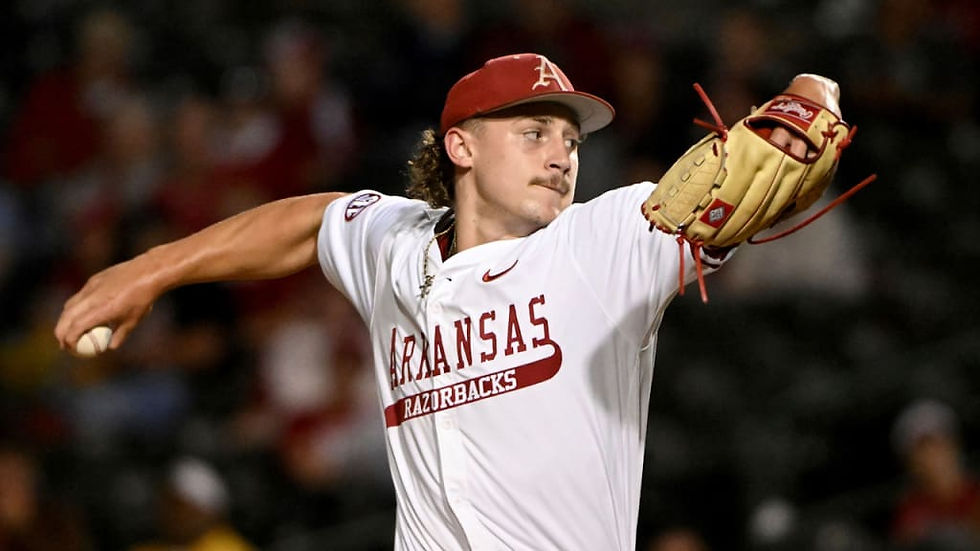
2025: 3.21 ERA - 1.14 WHIP | 14 IP - 7 H, 9 BB, 20 K
There are few pitchers likely to be available at pick 35 whom I feel are worth selecting. It is a class that is sparsely filled with pitching talent, especially at the college level. But Carson Wiggins is a name that does, at the very least, intrigue me. Though he comes with command and injury caveats, Wiggins has possibly the best “stuff” in the class—or at a minimum, the best two-pitch combination. He features a fastball that routinely touches triple digits with excellent life. He pairs it with his wipeout slider and broad arsenal of less-used off-speed options. If the Yankees could help refine his changeup—a pitch he showed feel for in HS but essentially abandoned in college—it would dramatically improve his effectiveness as a starting pitcher.
Wiggins missed all of this past season after blowing out his pitching elbow. At his brief bullpen session at the MLB Draft Combine, he pitched at limited capacity. He had below-average command over his pitches, but he already had control issues pre-injury, so the fact that he is rehabbing does not help. I do not expect the Yankees to go the route of a pitcher in the first round, but Wiggins might be attractive to them a round or two later (à la Thatcher Hurd).
Wiggins reminds me of Cam Leiter, who went 65th overall to the Dodgers in the last draft. He’s still in the midst of his rehab process, but his fastball-slider combo is as good a starting point as you get in this class. As I’ve said, I do not foresee the Yankees going for a pitcher in the first round. Wiggins is more or less here for posterity; which is to say, if they were to select a college pitcher (barring one of the top arms having a nasty draft slide), Wiggins is who I’d want. He is not guaranteed to stay on the board for their second-round pick. While he’d be a more dramatic under-slot selection than we’ve come to expect from the Yankees, they aren’t strangers to doing this with injured arms carrying legitimate first-round upside (Clarke Schmidt and Ben Hess come to mind).
4. Aiden Robbins, University of Texas | 21 | 6’2 205 | R/R | OF
2026: .333/.426 - 1.122 OPS | 36 XBH - 24 HR, 64 RBI | 39 BB - 65 K
The undisputed best hitter in the Cape Cod League in 2025, Robbins has been an absolute wrecking ball at Texas this season. After transferring from Seton Hall, where he torched Big East pitching, it was more of the same this year in the SEC. With high hands, Robbins takes an aggressive uppercut hack made to do damage. It’s a change in approach from his time at Seton Hall, but Robbins is doing more damage than ever. He’s making louder contact and hitting more home runs this season, but it has come with nearly double the strikeouts.
Though his aggressive approach has worked in the SEC, I am not convinced it will be the same story in the upper levels of the minor leagues. That said, he is an extremely gifted hitter who I don’t doubt can adjust without a serious drop-off in production. Given Robbins' bat path, the hand-eye coordination and barrel feel required to catch up to 90-plus mph fastballs are extraordinary. Still, breaking and off-speed pitches are a real concern for him, and more advanced pitchers will exploit that. If the Yankees select him, they will likely do two things: focus on his pitch recognition to avoid swinging through bad breaking balls, and adjust his swing path so it is not as loopy. Both adjustments will pay dividends for Robbins as he rises the minor league ranks.
In the field, Robbins has played center field, but he does not have the prototypical athleticism that the position demands. He will fit better at a corner, and his average arm should be all he needs out there. He seems destined to be selected at the back end of the first round, but his ultimate draft range will depend on how much teams believe in his hit tool.
3. Eric Becker, University of Virginia | 21 | 6’3 190 | L/R | SS

2026: .317/.427 - .961 OPS | 24 XBH - 7 HR, 42 RBI | 19 BB - 36 K
Last season, I evaluated prep shortstop Nick Becker; at the time Becker was among my favorite prospects for the Yankees’ 2025 draft. I was enamored with the bat-to-ball skills as well as the projection of his large, lanky frame. Eric offers much of the same. At 6’ 3”, he is just an inch shorter than his younger brother. Eric is quieter, both physically and personality-wise, but what he lacks in raw tools, he more than makes up for in polish and intangibles.
Eric has a mature approach at the plate. He is unwilling to sell out for power, preferring a contact-oriented approach. Though Becker is average at best defensively at shortstop, he plays above his physical gifts. With average speed and arm strength, Becker could remain at shortstop, but he may ultimately fit better at second or third base.
As a draft prospect, Becker reminds me of Trey Sweeney because both are big college shortstops with polished hit tools and questions about their ability to stick at the position. Nevertheless, Becker is the superior defender, and if Sweeney could stick at short, Becker definitely can. Although he had his version of a down season at the plate, I and many others are willing to cut him some slack because he has been a consistent college performer. If you are wondering what Becker’s ceiling looks like, I envision a shortstop version of DJ LeMahieu, a tough out through and through.
2. Peyton Bonds, Rutgers University | 20 | 6’5 225 | R/R | OF

2026: .352/.436 - .972 OPS | 15 XBH - 6 HR, 29 RBI | 13/15 SB | 16 BB - 21 K
Had it not been for George Steinbrenner’s hubris, Barry Bonds would’ve spent a large part of his career bolstering the Yankees’ burgeoning dynasty. Alas, it was never meant to be. Though Peyton may never eclipse his legendary uncle, he is still a very good baseball player. Even at 6’5”, 230 pounds—larger than both Bobby and Barry—Peyton can move. He plays an excellent centerfield with the kind of polish and instincts you would expect from someone born into baseball royalty.
Peyton inherited the hitting gene; he has an uber aggressive approach at the plate, with a great feel for making contact in-zone. Peyton has thunderous bat speed and generates some gaudy exit velocities, but Bonds has yet to fully tap into his prodigious raw power. Evaluators believe that a few mechanical changes could help him access that elite raw power in games more consistently. He was off to a scorching start this season, but a hamstring injury sidelined him for a bit. Still, Peyton ended the season slashing .352/.436/.535 to the tune of a .972 OPS in 36 games for Rutgers.
In the box, Bonds employs a poised batting stance with an easy right-handed swing. Given his tools and performance, it seems criminal that he’s projected to be a second rounder. While that might be his range, I doubt he’ll be available when the Yankees pick again in the second round. If they want him, they’ll have to take him 35th overall. If my top college target is already off the board, Bonds is more than worthy of being the selection.
1. Daniel Jackson, University of Georgia | 21 | 6’2 200 | R/R | C

2026: .379/.473 - 1.276 OPS | 47 XBH - 32 HR, 87 RBI | 26/28 SB | 44 BB - 64 K
Breakout is an understatement when describing Jackson’s 2026 SEC Triple-Crown season. When I watch Jackson, I can’t get the idea of a better version of Dalton Rushing out of my head. On top of being the more physical player, Jackson provides athleticism and speed that Rushing never had. This season, in addition to leading the SEC in nearly every important offensive category, Jackson ranked sixth in the conference in stolen bases. Jackson’s historic 25-25 season made him the first player to do so as a primary catcher in SEC history. I wouldn’t anticipate him being that kind of dual threat in MLB, but he should still have much more athleticism than the average backstop.
The one major knock against Jackson is that he still has a long way to go defensively. Last season, Jackson split his time between the outfield, DH, and catcher, but this season he was given the reins behind the plate. He is as raw as they come defensively, but he has above-average arm strength; he’ll just need to refine his technique and improve his accuracy. The same applies to his receiving. Although he is more athletic than most catchers, he still is learning the nuances of the position. If the defense was more polished, you could imagine a world where Jackson is a top ten pick.
Jackson has a violent righty swing tailor-made to hit home runs. There is power from foul pole to foul pole, though catching consistently might zap some of the offensive production. Still, he profiles as a prototypical middle-of-the-order bat that will also have the chance to provide value on the bases. Swing-and-miss is a concern for Jackson, and with mediocre contact rates, he will need to maintain his solid swing decisions to continue being a force on offense.
If the Yankees were to take Jackson, I trust Tanner Swanson (Yankees’ Director of Catching) to solve his defensive woes. There’s a nice—albeit very raw—foundation behind the plate that gives him a high defensive ceiling. Either way, if he does not work out behind the dish, he’s sure to stick in the corner outfield, and I like the bat enough that I would not be bothered by it. Though I am not sure he’ll be available at 35th overall, I am certain that if he falls there, the Yankees will take him.
Final Word
There were so many more players I wish I could have highlighted. I wanted to cover players that I felt fit the Yankees draft tendencies, while limiting the redundancy that comes with draft prospect analysis. The beauty of the MLB Draft is the boundless possibilities we are on the precipice of discovering—for the players and organizations. The 2026 draft class will be franchise altering for many teams, and though the MLB Draft lacks the glamour or instant impact of its peers in the NFL, NBA and NHL, it is just as integral to the game that we all enjoy. I hope my articles on this draft cycle, if nothing else, contribute to your excitement for the upcoming MLB Draft.
I want to thank MLBPipeline, Baseball America, and Perfect Game USA, among many others whose work scouting the 2026 draft class made this article possible. I also want to show my sincerest appreciation to YankeesFarm for featuring me as a guest writer and giving me a platform to put out my draft deep dives. I write stuff like this all the time on my Substack and Twitter (Yankees_Yapper), so if you enjoyed it, I'd love for you to check them out. Finally, I want to thank you for reading. There are countless ways to occupy your time, which is why I am so grateful that you chose to spend some of it here.

Every Prospect. Every Level. Every Day.
Comments