Early Look at 2026 Draft Prospects


We have reached the sad part of the year where we begin to close the books on the minor league baseball season. The regular season concluded for both the Tampa Tarpons and Hudson Valley Renegades on Sunday. While Tampa will at least get a few more playoff games in, the official stats for players are finalized. Over the next several months, I will do breakdowns of the past draft classes, but today I am looking over the 2026 draft class. Shortly after the draft, I wrote scouting reports for all 20 members of the class. 8 of the 9 collegiate hitters made their professional debuts, along with one pitcher. I wanted to take a look at their performance and see where these players met my scouting and where they have differed.
Paul Gutierrrez-Contreras, OF, Cal State Fullerton

“Contreras is a well-rounded offensive profile who showed big improvements between his sophomore and junior seasons. After hitting .259 with well below average contact and chase rates last year, Contreras posted very strong contact rates with some enticing power and an excellent chase rate this season, hitting .346 while walking more than he struck out. While he has shown some capability of pulling the ball in the air, there are some questions about his ability to handle velocity as he faces better competition.”
Contreras got off to a very sluggish start, with only 3 singles and a 38 wRC+ in his first 7 games, but has since grown more comfortable over his final 9 with a 175 wRC+. While it has been an uneven start of sorts for the outfielder, Contreras has some encouraging data. Contreras shows the well-rounded profile I scouted from his time in college, with above average swing decisions and contact ability. Perhaps most impressive is he’s showing very good power early on, with a 110.1 max EV and 107.9 90th% EV. This is very positive, as you don’t always know how guys will transition from metal bats to wood bats, but Contreras pop has remained enticing.
Contreras is also continuing to maintain his excellent discipline, as he has walked and struck out the same number of times to begin his professional career. The big questions that remain to be answered are still his pull ball ability and his ability to handle velocity. With only a 6.3 pullair% so far, this is something he will have to work on to improve in the offseason. As for the velocity, that will be tested as he sees better pitching. Overall, Contreras is living up this his college scouting report in a positive manner.
Bear Harrison, C, Texas A&M

“This is another prototypical Yankees prospect, featuring big power, good swing decisions, and some swing and miss. Specifically with Harrison, he has shown the ability to find the barrel and access power to the pull side. It is a big bat paired with improved swing decisions, walking more than he struck out this year… Harrison has above average outside whiff while having well below average zone whiff, suggesting some tinkering from coaching could help in the zone… There is work to do defensively, as he has room to grow as both a receiver and a blocker.”
Harrison has had one of the rougher debuts amongst the draft group, with only a 43 wRC+ in his first 20 games. That doesn’t mean everything is negative. One of the more surprising developments is that Harrison has made plenty of contact in the zone, with a 84.2% z-con. This is quite an interesting development, as Harrison had a 23rd percentile in-zone whiff in college. I pointed out in my scouting that he did better job making contact out of zone than in zone, so it was possible his hit tool could be fixed. Of course, his o-contact has been so poor that even despite above average swing decisions, he is still striking out 29.3% of the time.
The other positive has been his catching, as his framing has looked more advanced than I anticipated. This gives some hope about his prospects at not just staying at catcher, but being a good one. The issues we have seen stem from his power, surprisingly. His exit velocities haven’t been as strong as they were in college, and he has not pulled the ball in the air like he did in college. While the contact improvements have been encouraging, you do wonder if he has sacrificed his power for it. Hopefully in the offseason he can find a better balance.
Luke Pettitte, RHP, Dallas Baptist

“Instead of sitting on the bench, Pettitte picked up a bat and had a strong 2026 for Dallas Baptist as a DH, hitting 16 bombs with a 1.096 OPS.”
For Luke Pettitte’s draft review, I focused solely on the pitching side of things, as I expected that is where the Yankees would focus their efforts. I was wrong, as they have let Pettitte hit this summer while he finishes his TJ rehab. The results of his 11 games at the plate were impressive, as he blasted 4 home runs and a 136 wRC+. Pettitte showed strong power hitter traits, with good exit velocities, a feel for the barrel, and the ability to pull the ball in the air. His small sample also showed excellent swing decisions with a 71.4 zone swing vs 17% outside swing.
The main concern with Pettitte at the plate is his ability to make contact, as his whiff and zone contact rates were in the 23rd and 14th percentile, respectively. This led to an elevated 30.4 K% in his brief sample. We won't see Pettitte take the mound until the spring, as he is in the final push of his TJ rehab. While I still believe Pettitte’s future is on the mound, he is a fun watch at the plate and showed some traits that warrant giving him more runway as a two-way player.
Anthony Potestio, SS, University of California San Diego
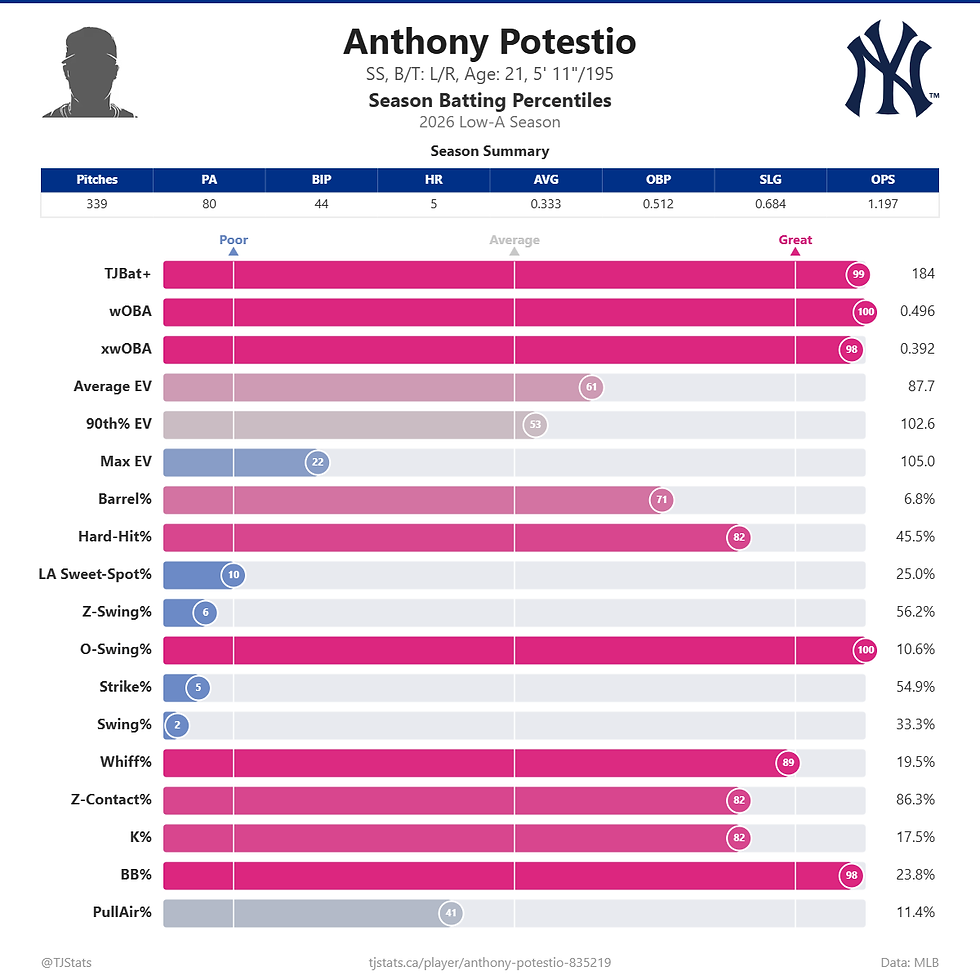
“Potestio is a hit-over-power offensive profile from the left side… still struck out at the same 15.8% as the year before thanks to his 99th percentile chase rate… He is a good bet to get on base, whether it be with the bat or with a walk. While he isn’t a big power profile, he does have some pop in his swing… This year, he did not pull the ball in the air enough, a clear area of improvement for him to gain some game power.”
Anthony Potestio was one of the best 2026 draftee performers this summer, not just for the Yankees but across baseball. In his 19 games, Potestio put up a sterling 203 wRC+, walking more than he struck out. Most encouraging were his 5 home runs. As I mentioned in my draft review, unlocking game power was a clear area for Potestio to improve on. While his raw power numbers were nothing to gawk at, with only a 105 max EV and 102.6 90th%, he was able to hit home runs in his small sample to all fields. While getting more to his pull side power is the safer bet for game power gains, and he did pull in the air at an improved rate from his college data, seeing some of the shots to left-center and straightaway center were impressive.
The standout tools for Potestio remain his contact and swing decisions. His 99th percentile chase rate followed him over to professional baseball, as he had a 100th percentile chase rate in Tampa at 10.6%. His 19.5% whiff rate was highly impressive as well. One area Potestio could look to improve is his swing rate. With only a 33.3% swing rate, Potestio is hardly swinging in the zone. With his good contact skills, I would like to see Potestio take more hacks, giving away a bit of chase for more zone swings. Overall, it is all positive with Potestio, as he is showing signs of combining his high-floor contact/decisions profile with more power.
Diego Castellanos, OF, St. Mary’s

“Castellanos has also shown a good eye at the plate, not expanding the zone and working a respectable amount of walks. It is another profile, like Potestio, that should yield high on base with the hitting and walking combined. There isn’t much power in the profile, though more game power could improve with more pull air. “
Diego Castellanos is another good performer, with a 113 wRC+ in his 19 games. In my write up, I mention that Castellanos and Potestio have extremely similar profiles, and that has played out so far in Tampa. While Castellanos I believe has a bit of an edge on pure contact ability, with a 16.2% whiff rate and 92.9% zone contact rate, the swing decisions and power are further behind Potestio. Castellanos is another infrequent swinger, with only a 37.4% rate, but his chase rate is double that of Potestio at 20.4%. While it is still good, it isn’t quite as strong, and doesn’t leave Castellanos as much to give back in return for more aggressive swing decisions.
The other area lacking for Castellanos is power. With both is 90th% and max EV’s sitting at the 12th percentile, he doesn’t impact the ball very well. While he did manage to hit 3 home runs, thanks to pulling the ball to right field, none of the homers left the bat over 100mph. While I think Potestio may have raised more eyebrows with his performance, Castellanos should still be a lot of fun to follow because he does make good contact and showed early signs of maxing out his game power.
Jason Krieger, RHP, Maine

"According to an article from his head coach, Krieger has a four-pitch mix featuring a four-seam fastball, sinker, cutter, and splitter. The coach also suggests the fastball has been up to 98, though it likely sits more in the low 90’s. Krieger shows a knack for generating soft contact, which gives a good base for a professional pitcher. We know the Yankees like the tri-force fastball, so if they can improve his stuff, it could become an interesting 4 pitch mix."
Jason Krieger, selected in the 17th round, was a surprise debut for Tampa, as he was only activated during the final week of the season and made 1 outing lasting 1.1 innings. With only 16 pitches thrown, it is hard to get too into what he looks like, but we can set a baseline. His four-seam fastball sat 94.2mph. The pitch shape as stands in pretty uninspiring, with below average iVB and spin and a steep approach. Still, it is good to see decent velocity. His slider, which sat 82.2mph, also lacks great shape and poor spin. He threw 2 cutters and 1 changeup, so it is hard to get too into the weeds here.
I think the big thing to keep in mind with Krieger is he has barely stepped into the Yankees pitching lab. This is the area the team develops the best. While his pitch shapes aren't particularly appealing right now, the Yankees can tinker and adjust these over the winter. One thing Krieger should work on outside of his pitches is his extension, as he only averaged 6.1 feet down the mound. The one pitch we didn't see that had been scouted was the sinker (the splitter could have been tagged as a changeup). We will see if he returns in April with 3 fastballs.
Blake Cyr, SS, Florida

“He has undergone an interesting shift as a batter, starting off as a big power shortstop with obvious swing and miss who wouldn’t chase and ending up as a free-swinging power hitter with good contact rates and few walks or strikeouts… With some good power numbers and ability to lift the ball to the pull side, Cyr could provide some nice offensive numbers for the Yankees affiliates after a good season in the SEC. If the Yankees can figure out how to match the swing decisions, he showed early in his career with the contact he showed late, it could be a very fun pick.”
Blake Cyr had a productive 11 games for Tampa, posting a 121 wRC+. One of the main takeaways I had with Cyr from his time in college is his transformation, as he switched from being low chase/low contact into a high chase/high contact hitter. Finding some stability between the two would be important for Cyr. That is why I am encouraged by what we’ve seen in his small sample. Cyr posted an excellent 70.3% z-swing vs 17.1% o-swing, getting his chase rates to a similar place to what they were in 2024. Meanwhile, Cyr still showed solid contact skills, especially in zone at 84.4%.
While the whiff rate is more league average due to missing on his chase swings, I do appreciate that he is continuing to post solid contact numbers. The power numbers look solid, with a 104.3mph 90th% exit velocity, paired with strong launch angles and pull air rates. Give it a larger sample, and I think Cyr could provide positive results for the Yankees system. I really like what I see early on.
Tyce Armstrong, 1B, Baylor

“He doubled his 2025 home run total from 12 to 24 while walking more and hitting for a better average. While he has big power, there is also big swing and miss, as you’d expect from a first base profile. Still, with respectable swing decisions, Armstrong will work walks. He projects as a low average, high on base minor leaguer, so the key will be how much he slugs. “
Veteran first baseman Tyce Armstrong was the 2nd best performer from the 2026 class, with a 159 wRC+ in his 21 games at Tampa. There was a ton to like from watching Armstrong, as well as looking at his data. I noted in my draft review how imperative it is that Armstrong slugs as a first baseman, and he did that in spades with 6 home runs. It’s not just that he hits the ball hard, with a 105mph 90th% exit velocity, but Armstrong lifts the ball very well. With a miniscule 26.4% ground ball rate and 30.2% pull air rate, Armstrong is maximizing his already strong power profile. The swing decisions have been very positive as well, with a 16.8% chase rate. This has aided a strong 15.1% walk rate.
We knew in college that Armstrong profiled as a higher OBP and Slug guy. What I didn’t suspect is for Armstrong to be much improved with his contact ability. With a 85.6% z-con and 23.9% whiff rate, Armstrong owns well above average contact rates. Truly, there is very little to critique in his early performance. The big thing for Armstrong, who is already 23 years old, will be how these skills hold up as he starts playing against competition that is more challenging, as he was likely too good for Tampa. While we may see some fall off in the contact rates, if he can still keep them around league average, I will really like what Armstrong could become.
Dean Toigo, OF, Arizona State

“Toigo is a free swinger, putting the ball in play quite frequently and running low walk and strikeout rates. There is some real game power there from the left side, though playing in Arizona may have inflated power numbers beyond the metal bats.”
Toigo was the last draft pick in the 2026 draft, and the only one to debut in Hudson Valley, as the 24-year-old skipped Low-A altogether. It was a solid but unspectacular debut for Toigo, who managed a 110 wRC+ in his 22 games. Toigo has stayed true to his free-swinging profile, with a 96th percentile swing rate. The contact wasn’t to the level I was hoping, as it regressed to a bit below average. This saw his K rate inflate well past what it did in college.
While Toigo didn’t hit any homers in his brief debut, he did hit 4 doubles and 2 triples. I would still like to see more power output given the lack of contact. Given his advanced age, there isn’t a ton of projection left here, but as we saw with Eric Genther this season, being 24 doesn’t prevent you from becoming a legitimate prospect.

Every Prospect. Every Level. Every Day.


Comments