The Yankees May have the Next Paul Blackburn on Their Roster

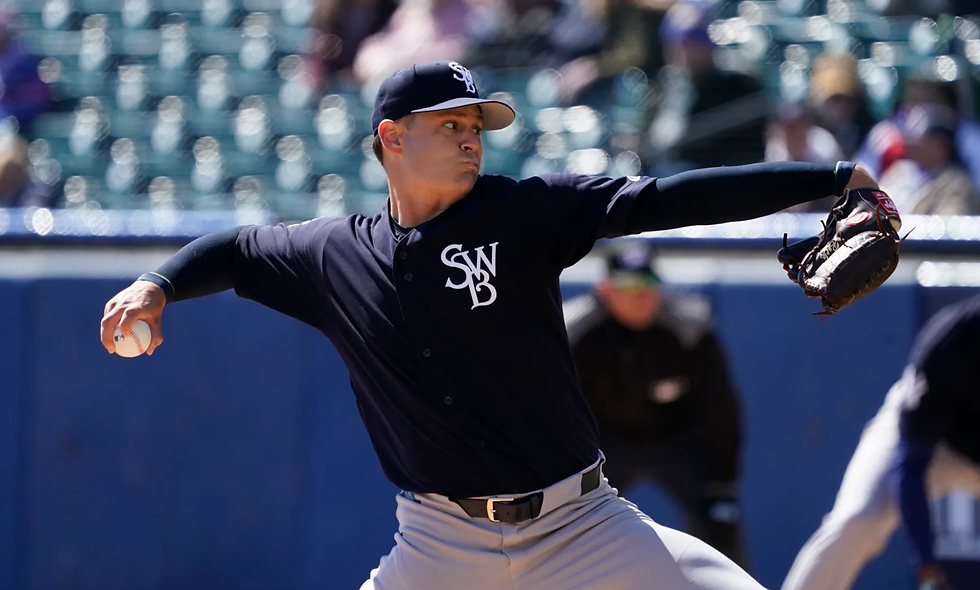
Former starting pitchers finding success in the bullpen is nothing new. Just look throughout the league and you will find guys who were once starters in the majors but would ultimately make the switch to reliever and established success. Some recent strong examples include guys like Jeff Hoffman, Brad Keller, and Antonio Senzatela. The Yankees themselves have benefited from this, finding waiver claim starters in Luke Weaver and Paul Blackburn and turning them into important bullpen pieces. The perks of moving to the ‘pen are clear; shorter spurts mean improved velocity and pitch shapes. This brings us to a Yankees pitcher who has been one of the better starting pitchers in AAA, but has struggled when given the chance to start or pitch in bulk for the Yankees. Indeed, Brendan Beck showed something in his garbage time 9th inning outing that makes me curious what a switch to a full-time reliever could look like. Let’s get to know Beck and what he’s done this year, how he could benefit from the change, and how other examples may pave the way.
Brendan Beck was selected in the 2nd round of the 2021 draft as a senior draft pick out of Stanford. He wouldn’t pitch for the organization until 2023 however, as he underwent Tommy John Surgery. He pitched well in 34 innings mostly spent at High-A. It was short lived, as Beck would miss the entire 2024 season due to ongoing elbow issues. He finally returned to the mound in 2025, pitching his first full season for the organization split between AA and AAA. He was dominant in his 54.1 innings at Somerset, with a 1.82 ERA and 2.52 FIP during his time there. His time at AAA was bit bumpier, but he still performed relatively well.

Beck was an interesting candidate to be taken in the Rule 5 Draft this past winter, but remained with the Yankees after not being picked. In AAA this season, Beck has been one of the best pitchers at the level. Per fangrpahs, The 27-year-old has pitched to a 2.75 ERA and 3.33 FIP with a 27.6 K% and 7.7 BB% across 121 innings. He ranks 5th in FIP and 6th in K-BB% amongst all pitchers in the international league with 50 or more innings. While the AAA domination has been nice, there were clear concerns about him being a AAAA type player, too good for AAA but not going enough for MLB. While he has a deep repertoire, all his pitches lacked velocity, with his fastball averaging 92.1mph. Some of those concerns were realized when he was knocked around some in his 2 bulk outings totaling 6.2 innings for the Yankees in which he averaged 92.1mph and 92.7mph, respectively. Still, on Saturday night vs the Red Sox, Beck showed some of the characteristics of a guy who could benefit from the role switch.
Switching from starter to reliever isn’t uncommon at all. Most of the relief pitchers in the MLB come up as starters in the minor leagues before switching roles. Then there are a handful or of guys who fail as a starter in the MLB, only to flourish as a reliever. The two most relatable examples of this for Yankee fans are Luke Weaver and Paul Blackburn. Let us begin with Weaver. Selected in the 1st round by St. Louis, Weaver was mildly successful for the Cardinals before being included in the deal for Paul Goldschmidt. After a solid first season in Arizona in 2019, things began to slip for the righty. After parts of 4 seasons in Arizona between 2019-2022, he ended that 2022 season with the Kansas City Royals. He then bounced between Seattle and Cincinnati in 2023 before he was picked up by the Yankees to help finish out the 2023 season for the team. He was brought back that winter, but this time with the plan to convert him to a reliever.
The success was nearly immediate, as Weaver had his best season since his first in Arizona. His fastball saw the immediate benefit, going from an average velocity of 94 in 2023 to 95.7 in 2024. There were other improvements as well, as he increased the spin on the pitch from 2402 to 2462rpm and the induced vertical break from 16.1 to 18.5. The pitch brought strong results, lowering his season-over-season xwOBA from .372 to .307 and increasing the whiff rate from 18.4 to 30%. His changeup, his best secondary pitch, also saw huge improvements, getting a multi mph velocity bump and a 16% bump in the whiff rate up to 48%. These improvements helped Warren become an integral part of the World Series run, ending the season as the closer. While his 2025 wasn’t as strong, he earned a nice contract this winter and has been having a year much like 2024 with the Mets and Pirates.
Paul Blackburn is another interesting study. Making the MLB with Oakland in 2017, he never fully established himself as a starter until 2022. After a solid 1.5 fWAR season in 2023, Blackburn was dealt to the Mets at the 2024 trade deadline to add some back-end rotation depth. He didn’t provide much value to the Mets in his 48 innings with them, getting waived by them in the summer of 2025, where he was picked up by the Yankees to eat some innings in September. The Yankees, like Weaver, brought him back in the offseason with the idea of making him a reliever. His role was awkward to begin the year, being more of a length guy in non-competitive games. However, Blackburn has grown as the season has gone on, and has now established himself as the 3rd best reliever in the bullpen and a reliable fireman, working the team out of many runners-on situations.
Blackburn’s primary pitch, his sinker, has seen a clear velocity bump from 92.6 in 2025 up to 94.3 mph. What is interesting about this pitch is it struggled early in the season, as it had a .409 and .408 xwOBA in April and May respectively. Since June, Blackburn has effectively cut the iVB on the pitch from 11 and 10.7 inches, down to 8.7 in August, seeing the pitch perform much better this summer. While his cutter has behaved similarly to last year besides adding a couple ticks of velo to it, the real success with Blackburn has been changing his pitch mix. Last year Blackburn’s most used secondary was his sweeper at 16.5%, followed by his curveball at 12.5%. They have rewritten the script this year, making his changeup the top secondary offering at 21.1% and upping the curveball usage to 14.6%. His changeup, which he throws about 1mph harder this year at 87.5, has been a very good chase pitch versus left-handers. Blackburn has added 2 inches of horizontal break and increased his whiff rate on the pitch by 5% season-over-season, leading to a .203 xwOBA. The curveball has been a summer change, bumping the usage in June, but has been his best swing and miss weapon. Between the velocity bump and pitch mix changes, Paul Blackburn went from a DFA candidate to reliable relief weapon.
How does all this relate to Brendan Beck? Well on the season in AAA, Beck has been primarily 4-seam fastball (40.3%) and slider (30.6%), with his curveball, splitter, and sinker (12.1, 7.8, 5.7%, respectively) all tertiary options. The fastball has some competitive shape metrics, as it has a 18.0 iVB with -5.2 VAA, 6.4 vertical release, and 2,179 spin rate. There is some nice ride with a decently flat approach angle and a tad below average spin. The velocity, sitting at 92mph, has kept the pitch at an average to below average offering. His slider, with some tight horizontal movement and decent spin, has been bullying AAA batters, with a supreme 42.1% chase rate and 46.1% whiff rate. Throwing these pitches for strikes consistently has also been helpful for Beck, as the strike throwing is one of the key aspects that will need to be translated to the MLB.

What we saw in his outing vs the Red Sox gave some insight into what these pitches could look like as a true reliever. His first pitch, a fastball strike looking to Nick Sogard, was clocked at 94.4mph with 2,373rpm and 20.0 iVB. He threw two other fastballs, one at 95 and another at 94.9 for balls, before finishing off the game with a 93.6mph fastball with 18.8 iVB, resulting in a flyout. Beck averaged 94.7mph on his 4 fastball offerings, and though the pitch shape metrics were inconsistent across them all, we know from his 18.0 iVB in AAA and the 20 iVB from Saturday’s game, he can get good ride on the pitch. While 2 of his 3 sliders were for balls and the other a foul ball, the 85.3mph velo was up over 2 ticks from his AAA average. This pitch has also been his most MLB proven offering, with a 48% whiff rate on his 50 total offerings.
There are other changes he could make to improve his supporting pitches, as his curveball could use a bit more spin and vertical drop, while his sinker would benefit from less iVB to give it more separation from the fastball. I do wonder if we could see Beck up his splitter usage, as I think it may be his third best offering. Even so, with his fastball and slider, Beck has two usable pitches. The key to this move, if it were to happen, is the consistency of his pitch metrics. Would Beck be able to pitch every other day and bring the 94-95 heat while sustaining good ride and flat approach? Can he continue to throw these pitches for strikes, his best attribute? These are questions that we wouldn’t know until this is a permanent move.
What we do know is no other team valued him as a starter last winter when he could’ve been had for free, and his 6.2 innings of bulk work didn’t inspire much confidence. If he were to remain a starter, it seems his ceiling would be stuck at best as a 5 on a non-playoff team. Turning 28 this off-season, the clock is starting to tick on Beck establishing himself as a major leaguer. The Yankees will need a bit of a makeover in the bullpen next year. Between some of the underperformers currently rostered and the inconsistencies of the true relief prospects they have in the minors, there could be a real runway for Beck if the Yankees decided to make this move with him.

Every Prospect. Every Level. Every Day.


Comments